Old Letters, Clippings and Photos as Memory Joggers: Getting Grandparents Talking
By The Glow Editors · September 26, 2026
Category: ask-them-now
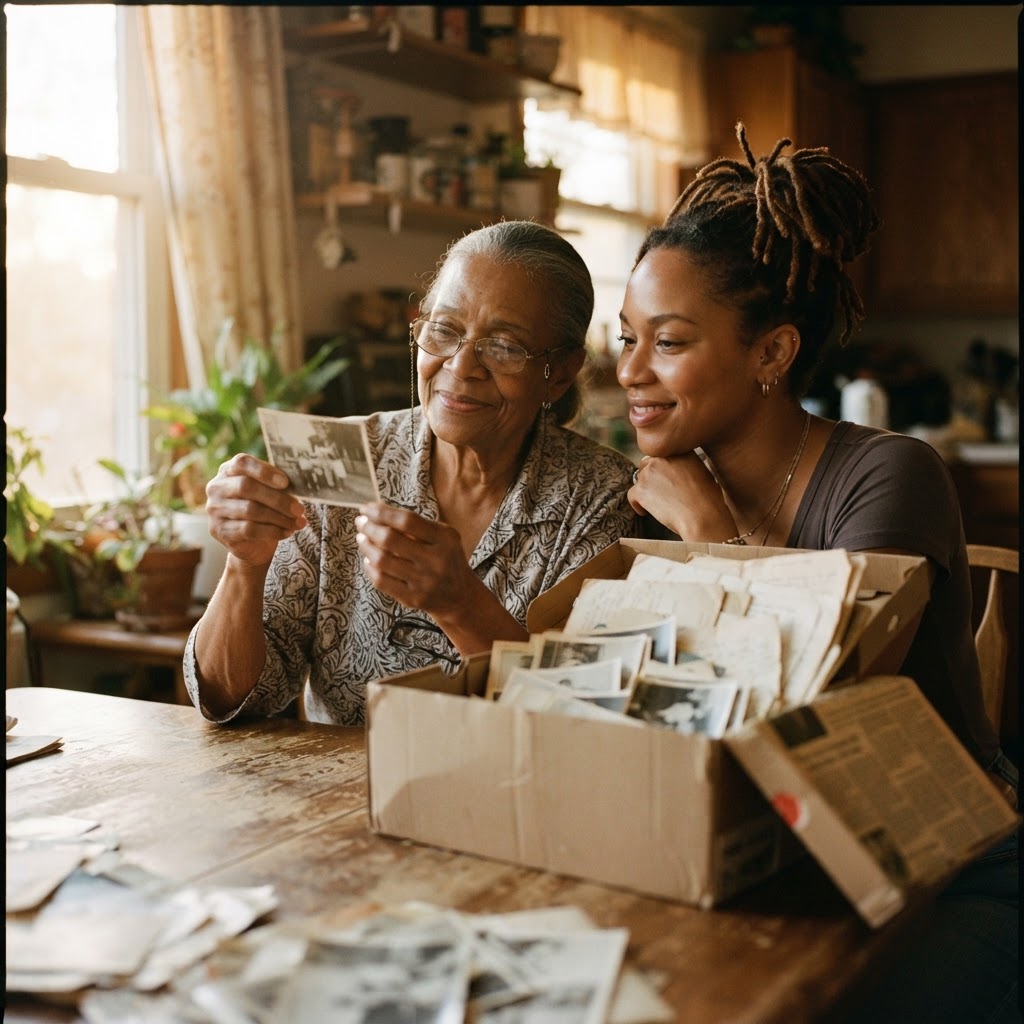
Old photos, letters, and newspaper clippings work as memory prompts for elderly relatives because the object does the asking - here's how to use them to get grandparents talking.
Key takeaways
The problem Grandparents often give short answers because open questions feel too large and formless to answer.
Core insight A specific object - a photo, letter, or clipping - does the asking so your grandparent has somewhere to start.
Practical outcome Use one object and one question per session to gather stories you can label, record, and share with your whole family.
You put a photo on the table in front of your father - him at maybe thirty, standing by a car you don't recognize, squinting into the sun. He picks it up. His face shifts. And then, without you asking a single question, he starts talking.
That's what memory prompts for elderly relatives actually do. The object does the asking. You just have to bring the right one into the room.
If your parent or grandparent gives short answers to direct questions - "I don't know," "That was a long time ago," "There's not much to tell" - it's usually not that they don't remember. It's that "Tell me about your life" is an enormous, formless thing to respond to. A letter from their sister, a newspaper from the year they got married, a recipe card in their mother's handwriting - these are specific. They have edges. They give your grandparent somewhere to start.
Ten objects that work as reminiscence prompts - and what to ask about each
Gather what you can in an afternoon. A shoebox counts. Here are ten kinds of objects worth looking for, and one opening question for each.
A photograph of them when young - "Who took this photo?"
A letter or postcard they sent or received - "Did you write back?"
A newspaper from a year that mattered to them (the year they married, emigrated, or started work) - "Do you remember reading the news that year?"
A birthday or Christmas card in someone's handwriting - "Who was this person to you?"
A ticket stub or programme (a concert, a sports match, a school play) - "Do you remember going to this?"
A recipe card or handwritten recipe - "Where did you learn to make this?"
A school report or certificate - "What do you remember about that teacher?"
A workplace document or pay slip - "What was a normal day like there?"
An address book or Christmas card list - "Who on this list would surprise me?"
A song from their teens or twenties (played on your phone or a small speaker) - "Does this take you somewhere?"
You don't need all ten. One or two objects is enough for a single conversation. Bring too many and the session starts to feel like a quiz.
How to set up the conversation so it actually works
Pick a quiet time when your grandparent is alert - a weekday afternoon usually works better than a holiday meal or an evening when they're tired. Sit somewhere comfortable, away from a loud television.
Bring the objects you've gathered, something to record with (a phone propped on the table works fine), and your permission to slow down. Ask before you record: "I'd like to record this so I don't miss anything - is that okay?" Most people say yes. If they'd rather you didn't, take handwritten notes instead.
Hand them one object. Not several - one. Let them hold it. Give them a moment before you say anything. Then ask your opening question and stop talking.
What they notice first is the thing worth following. If they pick up a photo and say "Oh, that kitchen," don't redirect them to the people in the photo. Ask about the kitchen. Questions about specific places - like the house they grew up in - can open up whole chapters of childhood that a direct question never would.
What photos unlock that questions don't
Photos are the strongest memory prompt for most people because they don't require your grandparent to find the memory from scratch. The image does that work. A photo of them at twenty-five in front of a house you've never seen can produce twenty minutes of detail that no question would have reached.
Print photos out, or show them on a large screen. A small phone screen held at arm's length is harder to engage with than something they can actually hold and point at.
When they're talking about a photo, useful follow-ups include: "Who else was there?" "Where was this kept all these years?" "Why do you think you kept it?" That last question is often the most revealing - the reason someone held onto an object for sixty years is usually a story in itself.
Old family photos often have no names or dates on the back. Ask your grandparent to name who's in them while they still can. Write the names in pencil on the back, or note them in a simple spreadsheet: photo name, approximate date, who's in it, what they said about it. If you're dealing with faces you can't place at all, there's a practical approach to identifying unknown people in old family photos that's worth working through before the conversation.
Letters, cards, and documents as memory prompts for elderly relatives

Letters reveal what photos don't: handwriting, tone, what someone worried about, who they were close to. A letter from a sibling, a love letter from before they were married, a note from a friend who's since died - read a line aloud and hand it over. "Listen to what your brother wrote here." That kind of invitation is very different from a direct question.
Prompts that work well with letters: "Who was this from?" "Did you write back?" "What happened with this person later?" "Why do you think you kept this one?"
Newspaper clippings and documents anchor personal stories to things that actually happened. A clipping about a factory where your grandparent worked, a wedding announcement, a church bulletin from a service they attended - these give them something external to react to, rather than asking them to perform a memory on demand. "I found this article about your workplace from 1978. Were you there when this happened?"
Old documents - birth certificates, address books, immigration papers - can surface family connections or moves they haven't thought about in decades. Don't save these for later. The conversation is the point; preservation can follow.
When something upsets them - and how to handle it
Some objects carry grief as well as memory. If a photo or a letter visibly distresses your grandparent, put it aside gently and move to something else. "We don't have to talk about this one." There's no obligation to visit every corner of a life in one afternoon.
Silence is not failure. If they go quiet after looking at something, wait. They may be remembering. They may come back to it, or they may not. Follow their lead.
And if details shift between tellings - a story set in one city last time, a different city this time - don't correct it. You're gathering their version of the story, not auditing it for accuracy. The way they remember it is part of what you're keeping.
Recording and keeping what you learn
Audio is often the easiest option: a phone placed on the table between you, voice memo running, left alone for the duration. Save the file with a clear name - "Grandma Ruth - letters and stories, March 2025" - and back it up somewhere you won't lose it.
You don't need to transcribe everything. After the conversation, jot down the key names and stories so you can find them later in the recording. A few keywords are enough. When a story trails off or you sense there's more to it, knowing how to ask a good follow-up question is often what turns a brief anecdote into something worth keeping.
Once you have stories attached to the objects, the objects themselves become more useful. You know the context. You can label photos, organize documents, and share what you've gathered with siblings or cousins who weren't in the room. In Glow, scanned photos appear alongside the questions they belong to, so the stories stay connected to the images rather than living in a separate document nobody opens. That's where this afternoon's work goes - not into a folder that sits on a hard drive, but into something the whole family can find.
Start with one object, one question, one conversation. The next one will be easier than the first.
Frequently Asked Questions
What if my grandparent doesn't remember details when I show them old photos?
Fragments are enough. If they say 'I think that was the house on Maple Street' or 'I'm not sure who that is,' that's still something. You're building a mosaic, not a complete record. Write down what they do remember, and note the gaps - sometimes a sibling or cousin can fill them later.
How do I get a grandparent to open up when they usually give short answers?
Short answers often mean the question was too open. 'Tell me about your life' has no edge to grab. A specific object - a photo, a letter, a ticket stub - gives them a concrete starting point. Hand it to them, ask one narrow question, and then wait. The silence after a question is where the story usually begins.
What are the best reminiscence prompts to use with someone who has memory loss?
Objects from their younger years often reach further back than recent memories. Photos, songs from their teens or twenties, familiar smells, and handwritten letters tend to work better than verbal questions alone. Keep sessions short, stay relaxed if details are incomplete, and focus on what brings them pleasure rather than what's accurate.
Is it okay to record the conversation without telling them?
No - always ask first. It's a simple question: 'I'd like to record this so I don't miss anything - is that okay?' Almost everyone says yes. Recording without permission risks breaking trust, which matters more than any single conversation. If they'd rather not be recorded, take notes by hand instead.
How do I get other family members involved in preserving these stories?
Share what you gather after the conversation - a photo labeled with a name, a short voice clip, a few sentences about what your grandparent said. Give people something specific to react to rather than asking them to participate in an abstract project. Most family members want to be part of this; they just need a small, concrete thing to do.