Map Her Life: The Places Your Grandmother Lived, and the Story at Each One
By The Glow Editors · September 26, 2026
Category: ask-them-now
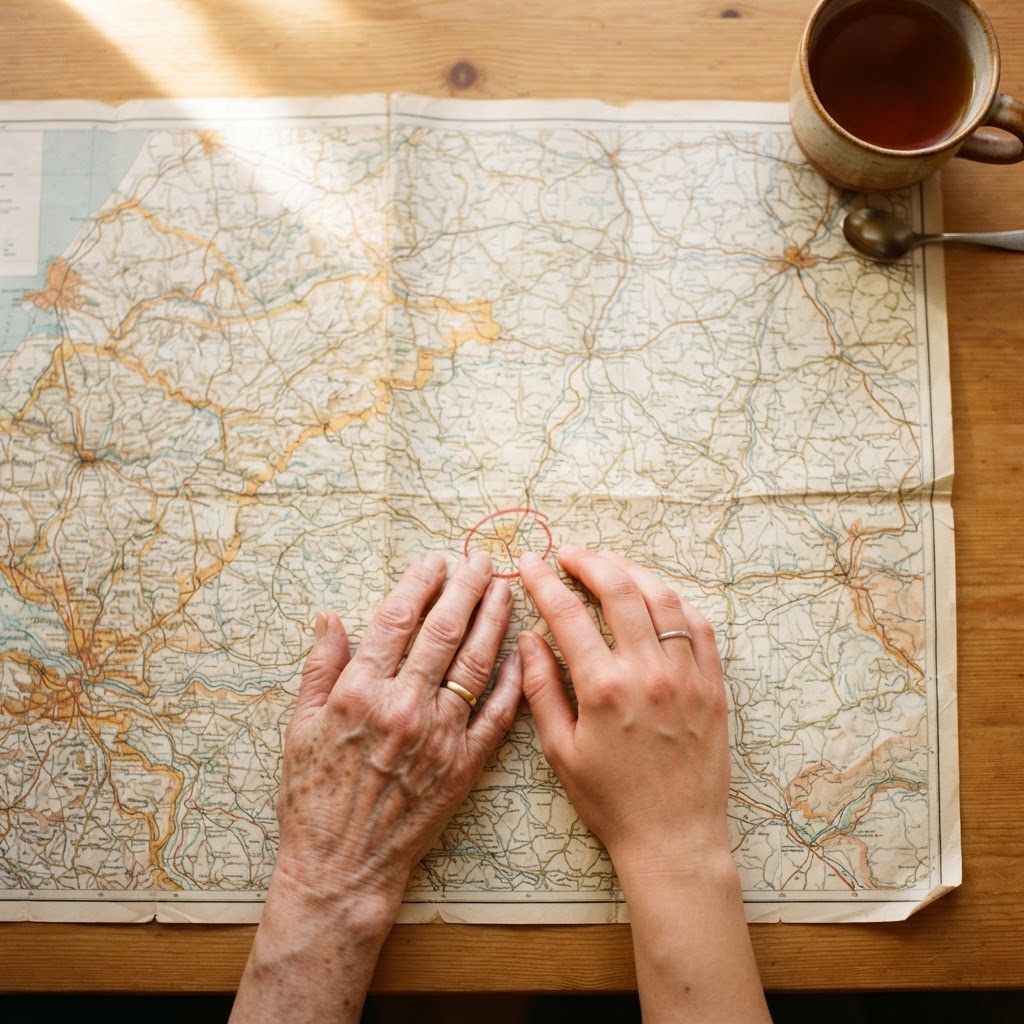
One of the most moving family history project ideas costs nothing: map every place your grandmother lived, sit with her at each pin, and ask four simple questions.
Key takeaways
The problem Most grandchildren know almost nothing about where their grandparents actually lived, or why.
Core insight Asking four questions at each place on a map unlocks stories no direct question ever reaches.
Practical outcome You can start and finish a rough map of her whole life in a single afternoon together.
You're sitting with your grandmother at the kitchen table, and you ask where she grew up. She says a town name you half-recognise, then mentions an apartment after she married, then a house two streets over, then another city entirely - and you realise you have no map in your head of where she has actually been. That gap is one of the most useful family history project ideas you can act on right now, and it costs nothing to start.
The project is simple: list every place she has lived, in order, then mark each one on a map. A paper map spread across the kitchen table works. A map on a tablet works. What matters is that she is there with you, watching the pins go down, and talking.
Before you start: what you need

Gather anything with addresses before you sit down together: old letters or postcards, a birth or marriage certificate, a photo album with location clues written on the back. You don't need every address perfect. Start with what you remember, or what one person can tell you in a phone call this week.
One gentle warning: don't wait for the right person to organise this. The aunt who remembers the farmhouse, the cousin who has old letters - ask them now, while they can still tell you.
The fastest way to build a grandparent life story map
Start with your grandmother's memory, not a database. Sit beside her, open a blank list on paper or your phone, and ask her to name the places she has lived from birth to now - or from now back to the beginning, whichever feels easier. Write down what she says. That list, however rough, is your map of places your grandparent lived. Everything else is detail you add around it.
You're not building a genealogy database. You're building a map of her life - the places that shaped her, and the people and stories that go with them.
Step 1: Make the list together
Ask her to walk you through it from the start. A simple opening: "I want to map out the places you've lived. Can you walk me through them, from wherever you were born?" Then listen. Write down the town, the street if she remembers it, the approximate years. Don't interrupt to correct or clarify - let the list come out first.
Some people find it easier to start from today and work backwards. Either direction is fine. The goal is a rough timeline, not a complete record.
This usually takes 20 to 40 minutes. If she pauses on a place, that pause often means something. Let it sit.
Step 2: Look each place up together
Once you have the list, open a map - a paper one if she prefers, or a map on a tablet or laptop - and look up each place in order. If the street still exists, try street view. Let her react. She might say the house is gone, or that the neighbourhood looks nothing like it did, or that there's the corner shop where her mother used to send her for bread.
At each pin, ask the same four questions:
How did you come to live here?
Who lived with you?
What's one thing you remember about the place?
Why did you leave?
Four questions is enough. The answers will lead somewhere you didn't expect. If the conversation opens up around a particular home, walking through the rooms of the house she grew up in can draw out memories that a simple address list won't catch.
Step 3: Record the conversation at each pin
Set your phone to record before you start the map - not as a formal interview, just a voice note running in the background. Tell her you're doing it: "I'm going to record so I don't forget anything - is that okay?" Most grandparents say yes without a second thought.
What you're capturing is not just the addresses. It's the way she describes the kitchen in the house where she was first married, or the specific word she uses for the neighbourhood she grew up in. That texture is the point. Knowing how to ask a good follow-up question in these moments is what turns a list of places into a real story.
Step 4: Add one photo per place
After the conversation, go through old photos together and find one image for each place - or each period, if photos are scarce. It doesn't have to be a photo of the building. It could be a photo of her from that time, or a photo of the people who lived there with her.
Write on the back of any printed photos, or add a caption in your phone's notes: the address, the approximate year, who is in the frame. Future family members will thank you for that one sentence.
Step 5: Notice the gaps and ask about them gently
Look at the timeline. Are there years with no place - a stretch of time that doesn't appear in the list? Ask about it quietly: "There's a gap here around 1971 - where were you then?"
Some gaps are mundane: she forgot a flat she rented for eight months. Some gaps are not. If she wants to skip a place, let her skip it. You can note that a move happened without recording why. The map can hold a silence as well as a story.
This works across countries and migrations. If she moved between continents, mark both. If the town she was born in no longer exists under that name, write both the old name and the new one.
If you can't find an exact address
Write down what you do know: the city, the approximate years, the reason for the move. A note that says "somewhere in Glasgow, mid-1960s, before the move to London" is not a failure - it's an honest record of what the family remembers. If you want to dig further later, city directories and old phone books are available through many public libraries and genealogy sites.
Your map doesn't have to be complete to be meaningful. It's the story that matters.
If family members remember things differently
Write down what each person says. If there's a disagreement about an address or a date, note both versions: "Mum remembers 123 Main Street; Aunt Susan says it was 456 Oak Avenue." That's not a problem - it's evidence that the memory lives in more than one person. The map is not a legal document. It can hold different versions of the truth.
Where to keep the map once it's done
A printed version in a family album is one good home. A shared digital document - a spreadsheet, a saved map, a folder of photos and notes - is another. Glow lays the family archive out year by year, so each place and its stories can sit on the family timeline alongside the photos and voice recordings you've gathered. Whatever format you choose, keep it somewhere other family members can find it and add to it. The map will grow after she is gone, as people remember things they didn't think to say.
What you end up with is a timeline of a life - the places she was born, married, raised children, started over, grew old. It's a way of saying: this is where she was, this is who she was, this is what we remember. Start with the kitchen table, one list, and four questions. Along the way, you might find that identifying the unknown faces in old family photos from each location adds another layer to the picture you're building. That's enough.
Frequently Asked Questions
Do I need to include every place she lived, or just the important ones?
You don't have to include every place. Start with the ones that shaped her life or that she talks about most. You can add smaller or shorter stays later as you find documents or hear from other family members - the map can grow over time.
What if I find out she lived somewhere nobody in the family knew about?
Ask her about it directly if you can: where it was, when, and why. Some places are private for reasons she'll explain; others she simply forgot to mention. Write down what she tells you and add it to the timeline without making it feel like an interrogation.
Can I do this if my grandmother has already died?
Yes. Start with the family member who knew her best - her sibling, oldest child, or a lifelong friend. Ask them to walk you through her life in order, the same way you would have asked her. Documents, old letters, and photo backs can fill in what memory misses.
What if she doesn't want to talk about a particular place?
Let her skip it. You can note that a move happened without recording the reason, and return to it another time if she chooses. Some places carry pain that doesn't need to be pressed on. The map is for her as much as it is for the family.
How do I share the map with the rest of the family?
A shared digital document or saved map works well for families who are comfortable online. A printed version in a binder or family album works for those who aren't. The goal is that other family members can find it, read it, and add their own memories to it - so keep it somewhere accessible, not just on one person's phone.