Found an Old Obituary or Wedding Notice? How to Turn a Newspaper Clipping Into a Family Story
By The Glow Editors · September 26, 2026
Category: family-archive
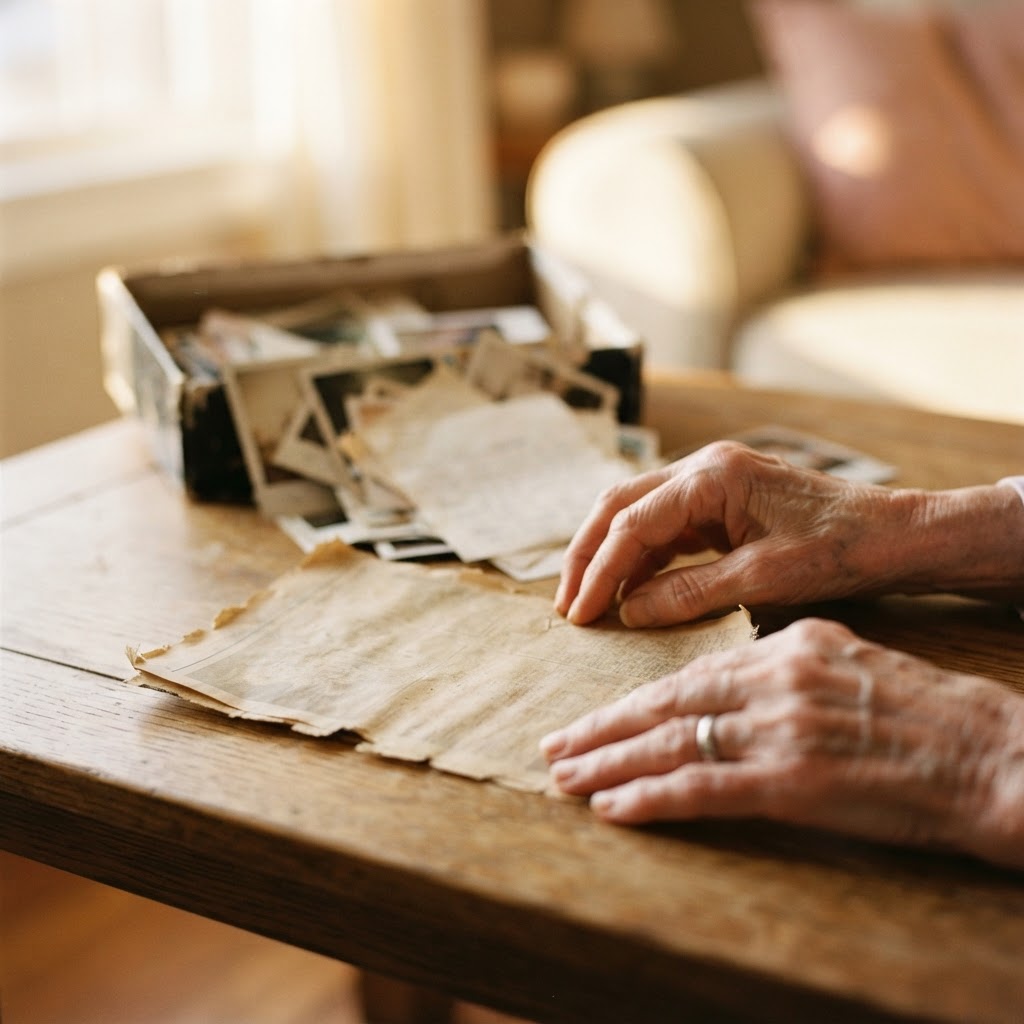
Found an old newspaper clipping in a relative's papers? Here's how to handle, photograph, and research it so the family story behind it doesn't disappear.
Key takeaways
The problem Old newspaper clippings decay fast and are usually stored in ways that speed up the damage.
Core insight One careful photograph and a few handwritten notes turn a fragile scrap into a permanent, shareable family record.
Practical outcome Use the names in the clipping as conversation starters with older relatives before those answers are gone.
You found it tucked inside a birthday card, or folded inside the back cover of a Bible, or loose in a shoebox that hadn't been opened since the move. A rectangle of yellowed newsprint - a wedding notice, an obituary, a birth announcement. Someone saved it once. Now it's in your hands, and you're not sure what to do with it.
Old newspaper clippings are one of the most common finds in family history work, and one of the most fragile. Newsprint is acidic. It browns and brittles quickly, especially when it's been folded, stored near other paper, or exposed to light. The moment you found it is actually the right moment to act - not because time is running out in some dramatic way, but because handling it once, carefully, and then putting it somewhere safe, is the whole job. Everything else builds from there.
Before you start: what to have in hand
Before you do anything else, set the clipping on a flat, clean surface. You'll want a phone or camera, a piece of plain paper for notes, and a pen. If you have an acid-free folder or envelope nearby, even better - but don't go searching for one yet. The clipping on the table is the priority.
One thing not to do: don't tape the clipping, don't laminate it, and don't fold it again along a crease that's already starting to split. All three options seem like preservation but they cause more damage. Tape yellows and pulls fibres off the paper. Lamination traps moisture and makes scanning impossible later.
You don't have to finish this today. You only have to start with what's in your hands right now.
Handle it gently - newsprint doesn't forgive rough treatment

Newsprint is acidic in a way that most other paper isn't. It doesn't just age - it slowly destroys itself, and it will yellow anything it touches for long enough. If your clipping has been folded inside another document, there may already be a brown shadow on the page it was pressed against.
Pick it up by the edges if you can. Don't press on the fold lines. If the clipping is in multiple pieces, don't try to reassemble it by hand - lay the pieces beside each other on the flat surface so you can photograph them together.
Photograph or scan it right away, in good light
The photograph you take today becomes your working copy. It means the original never has to come out of storage again for everyday reference or family sharing.
Lay the clipping flat. Use natural light from a window if you can, or a lamp held at an angle rather than directly overhead - overhead light flattens the contrast and makes faded text harder to read in the image. Take the photo straight down, not at an angle. Take two or three shots and keep the sharpest one.
If the clipping is very old or the text is very small, your phone's camera is usually sufficient. A flatbed scanner at a library or print shop will give you a higher resolution file if you want one, but a clear phone photo is enough to start. The point is to have a backup so the original can rest. The same principle applies to photographs - if you're wondering how to protect old family photos from floods, fires, and moves, the approach is similar: photograph first, store safely, and make sure the digital copy exists somewhere beyond a single device.
Read it carefully for every clue it carries
Once you have the photograph, look at what the clipping actually says - not just the main name or event, but everything around it. A wedding notice from 1952 might carry the bride's name and the groom's name in the headline, but the paragraph below might list the bride's parents, the church, the town, and the names of the bridesmaids. An obituary might name pallbearers, neighbours, and surviving siblings whose names you didn't know existed.
Write down every name, date, and place you can make out. Note the newspaper's name if it's visible, and the date. If a word is illegible, write [unclear] - don't guess. This transcription stays with the photograph as a searchable note, and it becomes the basis for the next step.
Turn each name into a question for an older relative
This is where the clipping stops being a fragment and starts becoming a thread. Look at the names you wrote down - the bridesmaid, the neighbour mentioned as a witness, the sister who travelled from out of state. Bring those names to an older relative, in person or over the phone, and ask about them directly. Old letters, clippings and photos work especially well as memory prompts - if you want to get more out of those conversations, there's a lot to learn from using clippings and photographs to get grandparents talking.
"Who was this bridesmaid? Did she stay close to the family?" "The obituary mentions a brother in Cleveland - did you know him?" These aren't research questions; they're conversation starters. The answer you get might not be accurate either - family memory is imprecise and sometimes protective - but record what you're told, and note it alongside the scan. A discrepancy between the clipping and a relative's memory is not a problem to solve on the spot. It's a question to flag and pass along.
Store the original away from other paper

Newsprint yellows what it touches over time. Once you have your photograph and your notes, the original clipping should be stored flat, in an acid-free folder or envelope, away from other documents. A cool, dry place - not an attic, not a basement if either runs damp or hot. If you don't have acid-free materials, a plain paper envelope stored inside a hard-sided box is better than a plastic sleeve, which can trap moisture.
The fold lines are the most vulnerable part. If the clipping has been folded, don't refold it - store it flat even if that means a larger envelope.
Share the scan and ask what anyone else knows
The scan is shareable in ways the original never can be. Send it to siblings, cousins, an aunt who might recognise the handwriting in the margin or remember the occasion. Ask simply: "Does anyone know more about this?" You may be surprised. The cousin who never seemed interested in family history sometimes turns out to have a matching clipping, or a memory that fills in the gap. When a response opens into a longer story, knowing how to ask a good follow-up question is often what determines whether that story gets captured or quietly fades again.
If you're gathering the stories and documents connected to this person - their photos, other clippings, voice recordings from older relatives, their letters - a shared family archive gives those pieces a place to live together. In Glow, the scan and the story behind it can sit on the family's year-by-year timeline, so the clipping isn't floating in a folder somewhere but placed in context, alongside everything else the family knows about that moment.
Start with what feels natural. A labeled folder on your computer is a real start. The clipping is already rescued; everything else is about making sure the story it carries doesn't stay locked inside a rectangle of yellowed newsprint that only you have seen.
Frequently Asked Questions
Can I trust the information in an old newspaper clipping?
Newspapers are primary sources, but they make mistakes - names are misspelled, ages are reported incorrectly, and details are sometimes softened for social reasons. Treat the clipping as one piece of evidence and cross-check it against other records like birth certificates, family Bibles, or a relative's memory. When records disagree, note both versions rather than deciding which is right.
What if the clipping is too fragile to handle?
If the clipping is actively crumbling or in multiple pieces, photograph it in place before moving it at all. A local library, historical society, or archive may offer free or low-cost scanning services and can advise on stabilisation. In the meantime, keep the pieces flat in a paper envelope and avoid any tape or adhesive.
What do I do if I can't make out part of the text?
Write [unclear] in your transcription rather than guessing - a guess recorded as fact can cause confusion later. Share the scan with older relatives, who may recognise a name or phrase that looks illegible to you. Libraries with digitised newspaper archives sometimes have a cleaner version of the same article, which can fill in the gaps.
Should I laminate the clipping to protect it?
No. Lamination seems protective but it traps moisture, accelerates the paper's deterioration, and makes any future scanning or examination impossible. Store the original flat in an acid-free folder in a cool, dry place, and rely on your digital photograph for everyday handling and sharing.
What if the clipping has no date or newspaper name on it?
Look at the reverse side - the back of the clipping often carries partial text from another article that may include a date, a section heading, or a place name. If not, ask family members if they remember which paper or which year the event occurred. Even an approximate decade helps when searching digitised newspaper archives.