Questions to Ask Your Grandfather: A Ten-Minute Sitting for a Man of Few Words
By The Glow Editors · October 28, 2026
Category: Ask Them Now

Some grandfathers answer a big question with a shrug. This page offers one short sitting built on objects, places and small how-questions, with a kind way to stop.
Key takeaways
The problem A grandfather who answers in one word makes a long question list feel useless.
Core insight Questions about objects, places and small how-steps give him an easier way in than questions about feelings.
Practical outcome You finish a ten-minute sitting with a named recording, a thank-you and a date for the next one.
He sits in his chair. You press record, and you ask what his school days were like. "Fine," he says, and the room goes quiet again. Nothing has gone wrong. One-word replies usually mean the question was too big to fit through the door.
So here is one sitting that fits in ten minutes. Use it once, and stop when he is tired. It is a plan to adapt, never a script to follow, and you can skip any line of it.
If your grandfather has already died, the same questions work with his brother, his old workmate or a neighbour. They remember him from outside the family, and that view is worth keeping.
Before the recorder comes out
Say aloud what you will do and who will hear it, then wait for his yes. If he says no to recording, ask whether you may take notes instead. If he says no to both, that is an answer too, and a gentle one to respect. The guide on recording someone who dislikes being recorded covers that case.
Then set the scene for a man who prefers doing to telling.
- Choose his place: the garage, the porch, the kitchen table, a drive in the car.
- Sit beside him, not across from him. Eye contact is hard work for some people.
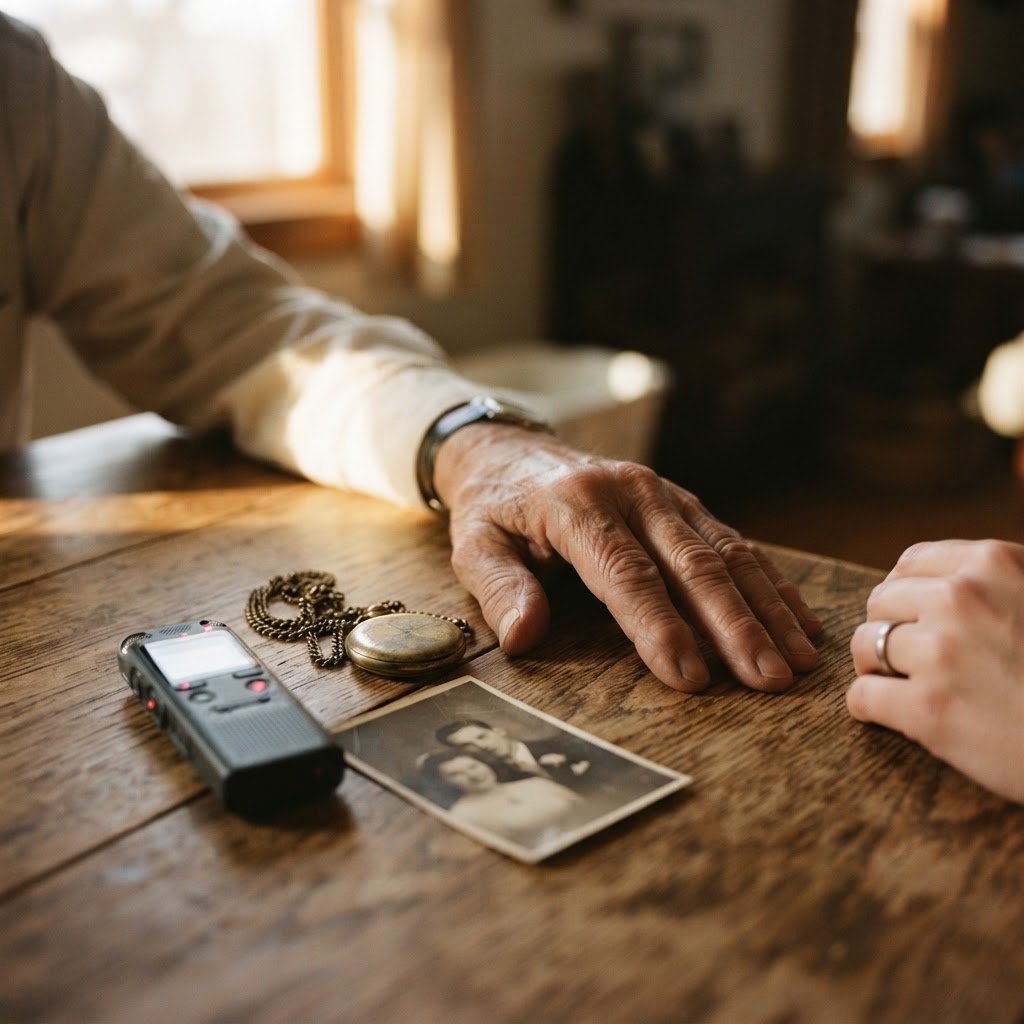
- Bring one object. A wrench, a watch, a medal, a worn photo. Hands busy, memory freer.
- Put the phone in airplane mode and test the sound for ten seconds.
Indiana University's oral history guidance advises arranging the interview in the place and time most comfortable for the interviewee, away from noise. That advice was written for historians. It suits a grandson with a phone just as well.
The ten minutes, one at a time
| Time | What you do | What you say |
|---|---|---|
| 0:00 | Press record and state today's date and his name. | "Granddad, what does this do?" |
| 1:00 | Warm up with an object. | "Where did you get this? What was it for?" |
| 3:00 | Ask about a working day. | "Take me through an ordinary morning when you were thirty." |
| 5:00 | Ask about a place. | "Stand at the front door of your boyhood home and describe what you see." |
| 7:00 | Ask about a person. | "Where were you standing the first time you saw Grandma?" |
| 9:00 | Close with something light. | "What is something you did well that nobody ever asked about?" |
| 10:00 | Thank him and stop. | "That was a gift. May we do ten more minutes next week?" |
After each answer, ask one small follow-up and then wait. Try "And then?", "How did your hands do that?" or "What did she answer?" The Do History toolkit, from George Mason University, puts it in four words: "Allow silence" and let it work for you. Count to five before you speak. A pause that feels long to you is thinking time for him.
When the answers shrink
- He says "It was fine." Ask what made an ordinary day good, or pass him the object once more.
- He drifts to another subject. Go with him for a while. That may be the story he wanted to tell.
- He says nobody cares about this. Tell him you do, and that you want to keep it.
- He tires. Stop right there, thank him and suggest another day.
- He goes quiet in a sad place. Pause the recording. Tell him you can leave that one alone, and mean it.
Why fewer questions beat a longer list
The usual advice for a quiet relative is to bring more questions. We think that is backwards. A list of a hundred prompts, like the long grouped lists on sites such as StoryWorth's guide to questions for grandparents, works for a talker. For a man of few words it is a stack of closed doors.
What opens a door is its shape. Indiana University's guide says to ask concrete questions, because memories "hang on substantial hooks". A typical day, a room, a tool: each is a hook. "Tell me about your career" is not.
The same page recommends open questions over yes-or-no ones, and so does the Library of Congress guidance reprinted by PBS Bill Moyers Journal, which asks interviewers to favour questions beginning how, when and why. None of this applies if your grandfather simply loves a long list. Then, by all means, use one. Read him first.
Five questions for the second sitting
- Who showed you the part of your work no one could write down?
- Where did you go as a boy when you wanted to be alone?
- What did a summer evening look like before there was a television?
- Which friend do you still think about?
- What would you teach me this afternoon, if we had a tool and an hour?
His job deserves a sitting of its own: try the what did they do all day questions. When words stay scarce, letters, clippings and old photographs may speak first.
What you keep afterwards
- A plain file name with person, topic and date, such as Granddad-first-pay-packet-2026-10.
- A second copy in a family folder he has agreed to, besides the one on your phone.
- One sentence of thanks naming something you did not know. It tells him the telling mattered.
- A date for the next sitting. Weekly ten-minute visits add up to a long story that nobody had to ask for.
If he agrees, play a clip back to him. Many men are quietly pleased to hear their own voice tell a story. If you want one private home for the audio, photos and notes, Glow keeps the real recording and nothing else. It never changes or invents a voice. A shared folder works as well.
Frequently Asked Questions
What if he says he has nothing worth telling?
Say that you would like to keep it anyway, then ask one small question about an object. If he still declines, thank him and leave it for another day.
How long should one sitting be?
Ten minutes is enough. A short, warm sitting makes the next one easier to agree to.
What if the memory upsets him?
Pause the recording and offer to skip the topic. Never press. If he is distressed for more than a moment, stop and keep him company.
Should I send him the questions first?
Some men like to think ahead, and some feel tested. Offer a topic, such as his first job, and let him decide.