Family Heirloom Stories: How to Record the Story Behind the Candlesticks Before It's Lost
By The Glow Editors · September 26, 2026
Category: family-archive
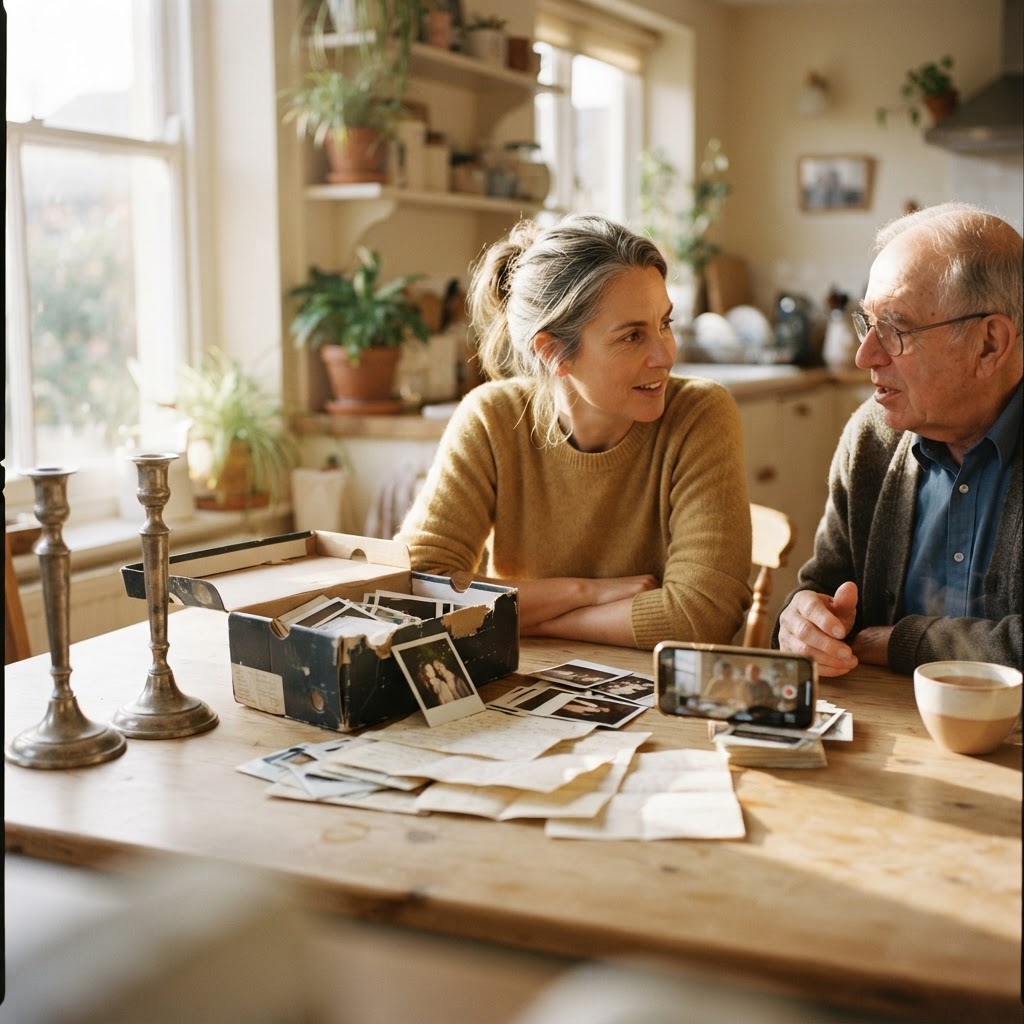
Family heirloom stories live in the person holding the object - here is how to record them before the moment passes, in seven practical steps.
Key takeaways
The problem Heirloom stories live in one person's memory and disappear when that person is gone.
Core insight Six questions asked while someone holds the object will unlock more than a long formal interview.
Practical outcome Walk the house, record the story, label the object, and keep the story and photo in one shared place.
You walk your mother through the house slowly, and she stops at the sideboard. She picks up the candlesticks - the ones that have always been there - and says something you have never heard before. Something about a town you cannot spell, and a sister who carried them in a coat pocket. You did not have a recorder. You did not even have your phone out.
Family heirloom stories live in exactly those moments, and they do not always come back around. The good news: you do not need a studio, a professional interviewer, or even an afternoon blocked off. You need the object, the person, and a phone.
The fastest safe way to record a family heirloom story
Open your phone's voice memo app, press record, and let the person hold the object while they talk. That is it. A voice recording captures tone, hesitation, the small laugh before the hard part - details that a typed summary loses. Video adds the hands moving the object, the face. A written note in a shared document works if recording feels too formal. All three work. None requires setup beyond pressing a button.
You can do this in one sitting, or over three phone calls. There is no right order. Here is how to start, step by step.
Step 1: Walk the house together and make a list
Before you record anything, walk through the rooms with the person who holds the knowledge. Move slowly. Let them lead. Ask: does this have a story? You will be surprised how many objects do - the watch in the drawer, the recipe box on the shelf, the sewing machine in the corner that nobody uses but nobody moves. Write down each object and roughly where it lives. This list is your recording plan, and it takes maybe twenty minutes to make. If you are finding it hard to get the conversation started, talking to aging parents about their life without it feeling morbid is easier than most people expect.
Time: 15 - 20 minutes.
Step 2: Ask six questions per object
When you sit down to record, you do not need a long interview. Six questions will open almost any heirloom story:
Who owned this first?
Where did it come from - a place, a person, a purchase?
How did it come into this family?
What was it used for, day to day?
Is there a specific moment you remember it being part of?
Who do you think should have it next?
These are not a quiz. If one question does not land, skip it and ask the next. The point is to give the story somewhere to go.
A note on hard stories: some objects survived war, migration, or loss. Let the teller decide how much to share. Your job is to open the door, not to pull anyone through it.
Time: 15 - 30 minutes per object.
Step 3: Record them holding it
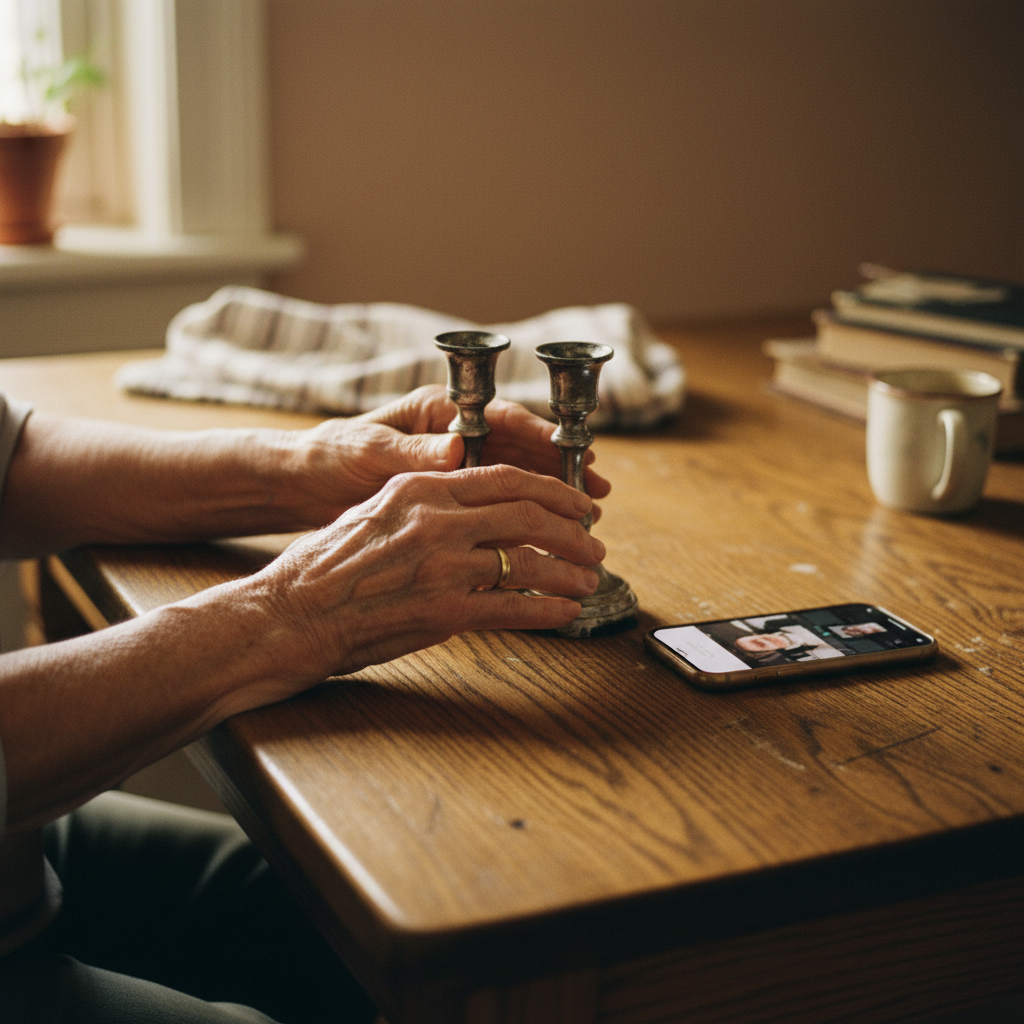
This is the step that most families skip, and it is the one they later wish they had done. Ask the person to hold the object while they talk. Something about having it in their hands loosens the story - they will turn it over, show you the mark on the bottom, demonstrate how the clasp works.
One technical rule: hit record, then put the phone face-down on the table where it can hear you both. You do not need to hold it or watch the screen. Let the conversation breathe. Do not interrupt to correct a date or ask for a repeat. The tangents - the cousin who broke one and cried, the year it moved from the dining room to the sideboard - are often where the real story lives.
Time: 15 - 30 minutes.
Step 4: Photograph the object properly
A recording tells the story. A photograph shows what you were talking about. Take both.
For each object: one photo of the whole thing in natural light, one close-up of any detail or maker's mark, and one with a hand in frame for scale. You are not making art - you are making a record. Straight-on or at an angle that shows shape and texture. Flat on a light surface works well for small objects like a brooch or a pocket watch.
Time: 3 - 5 minutes per object.
Step 5: Label the object so the story travels with it
A small paper tag tied to the object, or a handwritten note tucked into the drawer it lives in, is enough. The note only needs to say one thing: where the full story lives. Recording and photos: Google Drive, Johnson family folder. Or: Story recorded January 2024 - ask Mum or check the shared folder.
When the object eventually moves to someone else's home, the note goes with it. That is how the story travels.
Time: 2 minutes.
Step 6: Keep the story and photo together in one place
Name the file something you will recognize: Grandma Ruth candlestick story 2024 works. Voice Memo 47 does not. Check that the file is actually saved before you close the app.
For a lasting home, a shared cloud folder - Google Drive, Dropbox, iCloud - is free and easy to share across the family. If you want the photo and the recording to sit together with context, and you want other relatives to add what they remember, a private family space on Glow lets you do exactly that: the image of the object, the recording of its story, and a place for the cousin in another city to add the detail only she knows.
A physical backup - a printed sheet with the photo, the key facts, and a note that the full recording exists - is worth keeping in a folder or a box. Paper survives things that apps do not.
Time: 2 - 5 minutes.
Step 7: Have the conversation about who gets what
Once the story is recorded, there is one more conversation worth having gently, while the person who knows the provenance is still here: who should this go to next?
You do not need to resolve it today. You only need to ask, and to note the answer alongside the story. If you want to go further and capture the values and lessons behind the objects, not just their history, it is worth understanding what an ethical will is and how it passes down what matters most. When the time comes, the object will carry its history with it - and the family will know what it meant, not just what it is.
If the person is reluctant to talk on record
Some people feel self-conscious hearing their own voice, or they worry they will say something wrong. If that is the case, offer an alternative: ask them to tell the story while you take notes, and then read it back to them to check. Or ask them to tell it to a grandchild or a younger relative - a different audience sometimes opens a different version of the story. The goal is their words and their memory, not a polished performance.
If the person who knows the story is no longer here
You can still gather the story. It is just in pieces, held by different people now. Call an aunt, email a cousin, ask at the next gathering: do you know where these candlesticks came from? Write down what each person tells you, or record their answer. Over time, you will have a fuller picture than any one person could have given you alone - and a record of several voices, which is its own kind of family archive. If some of those voices exist only as old voice messages, it is worth knowing how to save WhatsApp voice notes from someone you love before they are lost.
The object is still there. Start with what it is, and let the family fill in what they remember.
Frequently Asked Questions
Do I need permission to record someone telling a family heirloom story?
Asking first is always the right thing to do, and most relatives are glad you asked. Simply say: 'I'd love to record you telling the story of this - would that be okay?' Recording laws vary by country, but within a family setting the more important thing is consent as a matter of respect, not just legality. If someone says no to being recorded, offer to take notes instead.
What if the older relative gets confused or contradicts themselves mid-story?
Let it go and keep listening. Dates shift, names get swapped - that is normal in any oral history, and it does not make the story less valuable. If you notice a significant contradiction, you can gently ask at the end: 'You mentioned two different towns - do you remember which it was?' Never correct mid-flow, or the story often stops.
What's the best app to use for recording heirloom stories on a phone?
The Voice Memos app on iPhone and Google Recorder on Android both save files automatically and are easy to find again. Either works well. The most important thing is to check that the file is saved before you close the app - play back the first ten seconds to confirm. If you want video, your phone's built-in camera app is enough.
What if I don't know anything about an object and neither does anyone living?
Start with what you can observe: the material, any maker's marks, the style or period, where it was stored and alongside what else. Write that down and photograph it. Post the photo in a family group chat with the question - someone may know more than you expect. Provenance can also sometimes be traced through estate records, immigration documents, or local historical societies, if the family history points to a specific region.
How do I make sure other family members can actually find the recording later?
Name the file clearly - include the person's name, the object, and the year - and save it somewhere more than one person can access, not just your own phone's camera roll. A shared folder in Google Drive or iCloud, with a link sent to two or three relatives, means the story survives even if one device does not. You don't have to get it all right the first time. You only have to start.